

Sapa - trekking and ethnic minorities
You can’t mention Sapa without talking about mountains, trekking/hiking, rice terraces, ethnic minorities, local villages, and rice wine. Sapa offers it all.
Sapa town is located in northern Vietnam, approximately 5-6 hours drive from the capital, Hanoi, and about 36 km or 1 hour’s drive from the border with China.
The town of Sapa is where most people arrive and depart from.
Sapa town has changed quite a bit in recent years since the highway has been extended from Hanoi for most of the way. On weekends, many locals drive to Sapa, which can make the streets a bit chaotic.
If you walk around the town, you’ll find many small restaurants and spa/massage places.
For many visitors to Vietnam, Sapa in the northwest corner of Vietnam is their favorite destination. Sapa and the surrounding area are not just beautiful nature with picturesque mountains and rice terraces, but also an exciting encounter with ethnicity in the area.

The town is a charming ‘Hill station’ in northern Vietnam (1500 meters above sea level) – near the Chinese border. The town was established by the French in 1922, but over the years, many of the beautiful colonial buildings have decayed. Approximately 3000 people live in Sapa. Many refer to the region as the Tonkinese Alps, and the area is famous for both its fine, rugged nature and its rich cultural diversity.
The region is home to many mountain tribes, rice terraces, lush vegetation, and Mount Fansipan, the highest mountain in Vietnam and old Indochina (Vietnam, Laos, Cambodia). But due to an increasing number of tourists in the area, Sapa has quickly become a place where money plays a much more central role in the locals’ mindset. Unlike most places in Vietnam, here you will encounter vendors who can be very persistent when trying to sell their goods.
It’s also worth checking out some of the colonial buildings left by the French colonialists, such as the church, the square, and the town hall.
How do you get to Sapa?
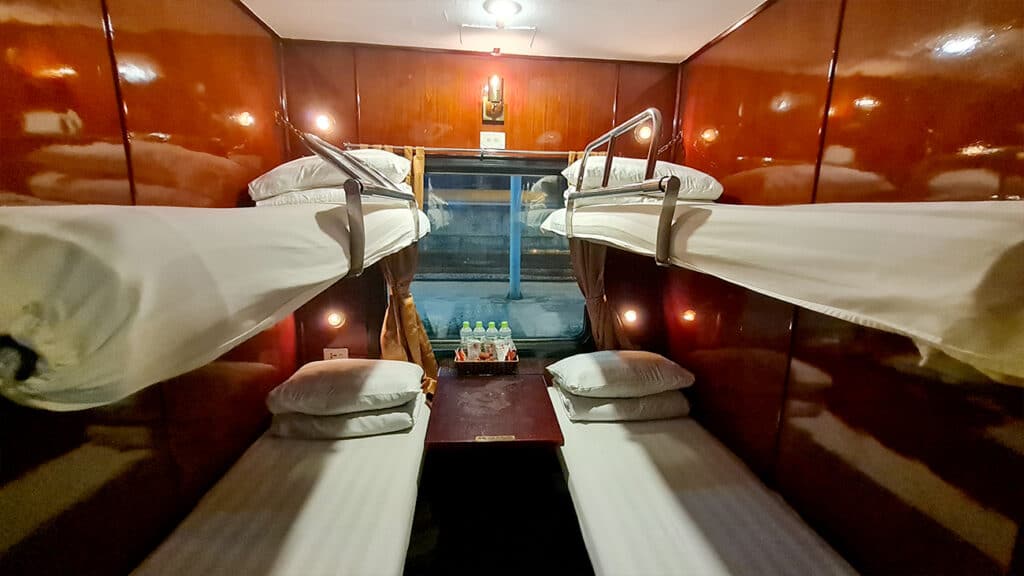
There are 3 ways to get to Sapa – by night train, bus, or private car.
The train from Hanoi to Lao Cai station takes about 8 hours. Upon arrival at Lao Cai station, there’s about a 1-hour bus ride to Sapa town itself.
By car or bus, it takes about 6 hours and takes you directly to Sapa town. In recent years, a new type of sleeper bus has been introduced, where you have your own small cabin. However, you shouldn’t be much over 180 cm tall to lie comfortably with bent legs.
For me personally, the train is more charming than the bus or car.
Most of our guests choose to travel by train, despite the longer travel time. The train itself is an experience.
There are different classes on the train, and we recommend the 4-bed cabins, also known as soft beds. Although it’s called soft beds, don’t expect luxury. It’s a decent and, for most people, comfortable way to travel.
Some say they slept well and had a good trip, while others say they would never do it again, but they’re glad for the experience afterward. Not everything on a trip to a country like Vietnam is always smooth sailing; some experiences aren’t fun in the moment, but the memories and subsequent reflection mean many wouldn’t have missed it for the world.
Etniske minoriteter
In the area, there are many ethnic minorities – in fact, there are 8 minority groups here:
- H´mong
- Dao
- Tay
- Giay
- Muong
- Thai
- Hoa
- Xa Pho.
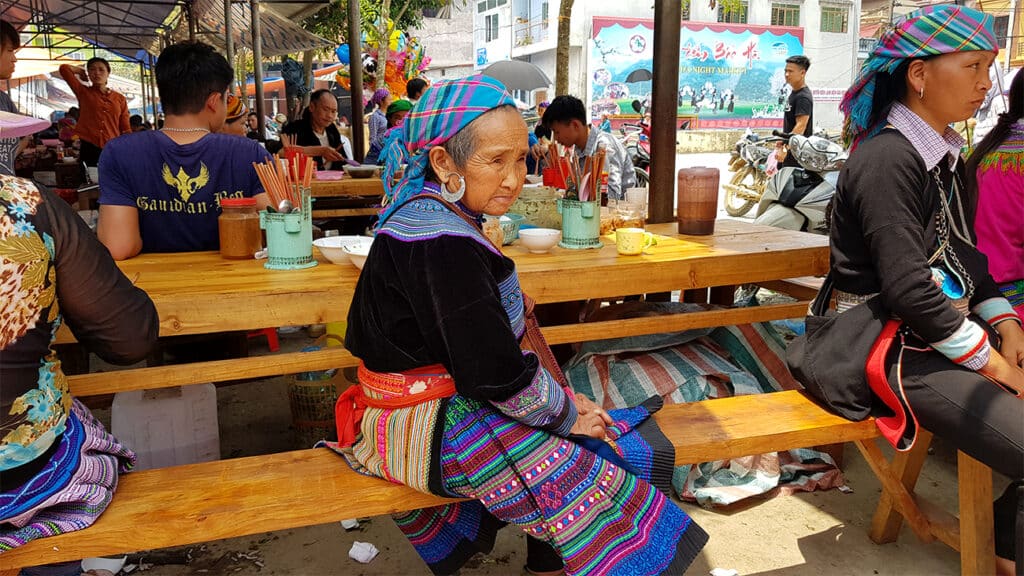
However, the first 4 are the most prevalent. 52% of the population here are H’mong, and 25% are Dao.
The ethnic minorities strive to make a living from the many tourists, and especially older women and children constitute the commercial face outwardly.
Marriage occurs early in this region, and it’s not unusual for marriages to take place between the ages of 15 and 18. Poverty is significant, and it’s not uncommon to see very young girls with two children.
Many of them still wear their traditional and very colorful clothes. If you choose to stay in a homestay, you get a bit closer to the locals.
Trekking in Sapa
Sapa is famous for its trekking tours, and with a local guide, these tours can provide fantastic insights into life in the region as well as some incredible nature experiences. The many rice terraces are best seen on these trekking tours. There are varying levels of difficulty in the routes, making them accessible to most people. Many choose to stay overnight in one of the villages in a homestay, thereby experiencing life in the mountains.
Sapa offers something for everyone. So whether you’re into family-friendly hiking or medium to hard trekking, Sapa is worth a visit.
If you prefer cycling, that’s also an option in Sapa.

Mountains & Rice Fields
Sapa offers scenic surroundings, with mountains and rice terraces stretching as far as the eye can see.
Whether you prefer an easy hike on the small gravel and asphalt roads, balancing on the 20 cm paths between the rice fields, or something more demanding, Sapa is ready to dance with you.
Get Around by Car or Motorcycle
If you’re physically unable to hike or cycle in the mountains, there are a couple of other alternatives.
We can hire a driver who can take you on the back of a motorcycle, so you can still get out into the mountains and have an adventure.
Sapa can also be experienced by car.
While you may not be able to venture as far as on a motorcycle or by trekking, you can still meet the locals and enjoy the fantastic views and beautiful nature Sapa has to offer.
Weather in Sapa
In Sapa, there are 4 seasons, and locals boast that you can experience all 4 seasons in one day. It’s cool in the early morning hours, warm and comfortable in the hours after sunrise, hot in the afternoon, and cold at night.
In winter (from November to February), it’s always cold in Sapa, and it can be wet and foggy. In rare cases, the temperature can drop to freezing, and it can snow. That being said, and if you dress accordingly, Sapa is still beautiful in its own way and worth visiting. However, there are no rice fields during this period.
In summer, it’s still possible to visit Sapa despite the rainy season; you should be aware that it can rain, and mud can be part of the hiking experience in the mountains. July and August are very wet, and it can rain a lot – but it’s also during this time of year that the rice terraces are most beautiful.
The best time to visit Sapa is from March to May when the weather is stable with cool nights and sunny days.
From September to November, it gradually gets cooler, but it’s also in September and October that the locals are very active in the fields during the harvest, and the rice terraces can be seen in yellow and brown colors.
Where to stay in Sapa?
Sapa offers a variety of accommodations, including hotels, homestays, and bungalows. Read more about each option below.

Homestay i Sapa
Når du er ankommet til Sapa by, og starter din vandring går turen for de fleste ud i bjergene mod et homestay.
Et homestay kan både være et lille hus hvor de har et ekstra værelse eller to. Det kan også være et hus der har fået udbygget førstesalen eller tilbygget nogle værelser til gæster.
Homestay er ofte som standard en form for sovesal. Er du ikke til det, beder du os blot booke et privat værelse til jer. Vær dog obs på at væggene her kan være af tynd bambus eller tilsvarende.
Hotel in Sapa
Sapa boasts plenty of hotels to choose from, catering to every taste.
Don’t expect the quality of the hotels to be the same as in the cities. Sapa, especially in winter, is cooler, and when combined with the humidity, it just provides a different atmosphere in a hotel.
If you’re traveling in winter, there’s heating in the rooms, of course, but not in common areas like the lobby and restaurant.
If you wish to stay in a hotel, perhaps a higher-end one, we can certainly find one for you; just send us your preferences.
It’s not immediately obvious, but when staying in a hotel, you can’t venture as far into the mountains as you can when staying in a homestay. This is because you have to return to the hotel the same day.
Bungalows
There are more and more options for staying in bungalows. So if you’re into bungalows, that’s also an option.
When you book a trip with Sapa included through Travel More Asia
- We ensure that you always have your own guide; you do not share your guide with others.
- We arrange for you to be transported from your hotel in Hanoi to the train, ensuring you board safely and find the correct cabin.
- We arrange for you to be picked up at the train station in Lao Cai and driven to Sapa town.
- From there, you have your very own guide for the rest of the trip.
Good to know:
It’s worth noting that there may be others staying at the same homestay as you. Additionally, you may need to share a car with others from the train station in Lao Cai to Sapa town – (the journey only lasts 1 hour).
FAQ
- You often come across a small hotel where you can store the luggage you won’t need on the trekking/hiking tour itself. You return to this hotel before you take the trip back to Hanoi or continue your journey around Vietnam.
- If you want a private cabin on the train, simply request it at the time of booking (additional charges apply).
- You can ask us to book a private room for you during overnight stays in a homestay if you prefer.